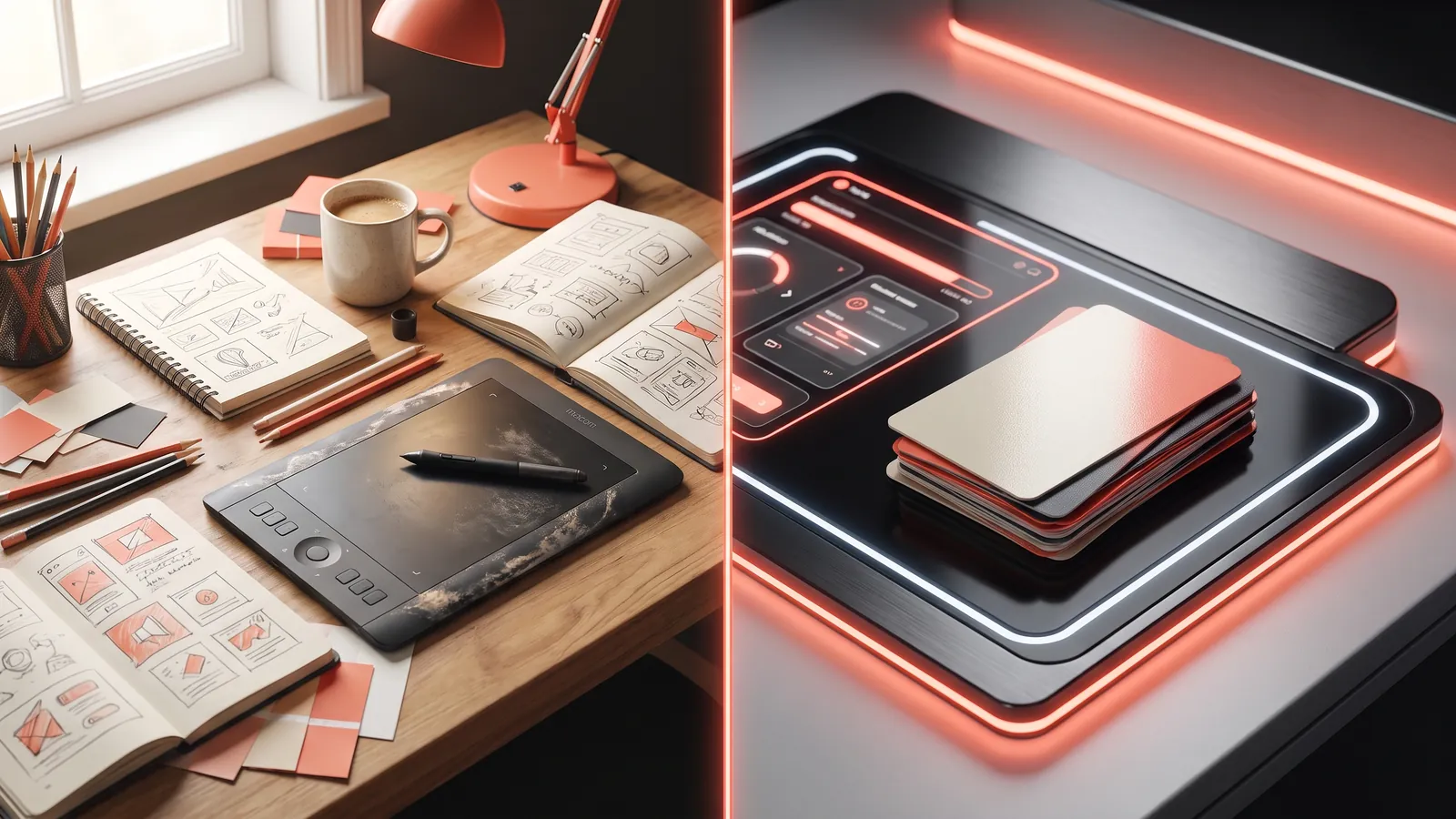
Most marketers believe AI ad generators are a budget shortcut that trades quality for speed. That framing misses the point: used well, AI generators let you test far more angles than a manual workflow allows, and more tested angles give you more chances to find a winner. Judge them on your own results, not on anyone's headline numbers.
That reframes the entire debate around AI ad generators vs freelance designers. The question isn't whether AI can match human creativity. The question is knowing exactly when to use each, and in what sequence.
Key Takeaways
- A meaningful creative test needs many variants, and paying per asset for all of them adds up before a single impression runs
- AI generators produce a batch of variants in minutes; skilled designers produce fewer, more considered pieces over a longer turnaround
- Hybrid workflows (AI volume first, human refinement second) combine the strengths of both approaches
- Freelancers still win in luxury brand positioning, regulated industries, and campaigns requiring deep cultural nuance
- The real decision framework is a sequence, not a binary choice
Table of Contents
- The Production Cost Floor: Where the Math Forces a Decision
- Why AI Ad Generators vs Freelance Designers Is the Wrong Question at Scale
- When Freelancers and Hybrid Teams Still Outperform Pure AI
- Building Your Decision Framework: A Practical Checklist
- Key Takeaways by the Numbers
- Frequently Asked Questions
The Production Cost Floor: Where the Math Forces a Decision
Freelance designers charge per asset, and video or UGC clips cost more again. Suppose a designer charges $X per static ad: a creative test of 20 variants costs 20 × $X in production before a single impression is served. That number is the Production Cost Floor: the point at which freelance-only production starts consuming your media budget rather than supporting it.
The threshold shifts depending on your monthly ad spend:
- Small budgets: One freelance project may cover your needs. AI tools are optional but worth testing.
- Mid-size budgets: Freelance production for 20+ variants can eat a large share of your budget. AI becomes economically necessary.
- Larger budgets: At this level, creative throughput is your primary constraint. AI generation isn't a cost decision, it's an operational one.
- Very large budgets: Hybrid is the only viable model. Volume and speed require AI; brand integrity and compliance require human oversight.
The math behind this matters. Every creative needs some media spend before its performance data means anything. Call that amount $Y per creative: test 5 creatives manually and you spend 5 × $Y on data collection.
Test 30 creatives with AI and you spend 30 × $Y, but you've covered far more angles, which raises your odds of finding a winner that converts more cheaply. More data finds better winners. Better winners reduce CPA with AI ad creatives.
AI brings the production cost per variant down sharply. That capital moves to media spend and data collection, which are the actual growth levers. The Production Cost Floor framework makes this trade-off concrete: once per-asset production costs start to rival your media budget, the math argues strongly for AI-first production.
If you're running a smaller operation, the same logic applies at a smaller scale, as covered in this guide to AI ad maker for small business.
Why AI Ad Generators vs Freelance Designers Is the Wrong Question at Scale
The real constraint separating 2026 winners from the rest isn't creative quality. It's creative throughput. Volume enables testing. Testing finds winners. Winners compound.
Not all AI-generated volume is equal, and this is where most comparisons go wrong. Tools that randomize 20 variations of the same hook don't outperform freelancers. Tools that generate structured angles do. The difference is methodology, not technology. This piece on how AI ad generators test creatives faster makes the same point: structured variation gives you clearer answers than random output in performance campaigns.
Structured angle generation means deliberately building variants around distinct psychological frameworks:
- Pain-point angle: What problem does this solve, and how acutely does the audience feel it?
- Social-proof angle: Who else has succeeded with this, and what did they achieve?
- Urgency angle: Why act now rather than later?
- Comparison angle: How does this option outperform the alternative?
Generating four variants of each angle gives you 16 creatives that cover meaningfully different psychological territory. Randomizing 16 variations of one hook gives you noise. The ability to generate ad concepts in seconds only creates value when those concepts are structurally distinct.
The Iteration Velocity Equation
Finding your winning creative in Week 1 versus Week 4 isn't just a timing difference. It's a revenue compounding problem. If you find your winning ad in Week 1 of a 12-week quarter, you have 11 more weeks to scale it.
Find it in Week 4, and you have 8 weeks. That's nearly a month less runway on your best-performing asset, which translates directly to quarter-end revenue outcomes.
Claivra's URL-to-Ad workflow is a practical example of structured angle generation done right. Paste a product URL and the AI ad creative generator produces several unique ad concepts, each built around a distinct psychological hook, complete with images, headlines, and CTAs. That's structured variation, not random output.
When Freelancers and Hybrid Teams Still Outperform Pure AI
AI wins on volume and speed. Humans win on judgment. Knowing where judgment matters most is the strategic skill.
There are specific campaign types where human expertise is not optional:
- Luxury brand positioning: High-end brands like those in the LVMH or Kering portfolios rely on art direction that communicates exclusivity through visual restraint. AI tools trained on broad datasets tend to produce creative that reads as competent but not aspirational.
- Regulated industries: Pharma, financial services, and legal advertising carry strict compliance requirements from bodies like the FDA, FCA, and FTC. AI-generated visuals carry trademark, copyright, and regulatory risks that human designers working within brand guidelines and legal review are trained to avoid.
- Deep cultural nuance: Campaigns targeting specific regional or ethnic audiences often require cultural context that goes beyond language localization. Human creative directors with lived experience in those markets produce work that AI cannot reliably replicate.
Creative fatigue is another area where human oversight becomes critical. AI tools without editorial control can flood an audience with structurally similar ads, accelerating saturation. A human creative director's intervention, refreshing the visual language or reframing the angle cluster, resets performance in ways that automated variation cannot. This is why the hybrid model exists.
The Hybrid Model That Top Teams Use in 2026
The advantage of hybrid workflows doesn't come from using AI and humans simultaneously. It comes from sequencing them correctly:
- AI generates 15–20 structured variants across defined psychological angles
- Human reviewers select the top 5 based on brand fit, compliance, and insight quality
- All selected variants run through paid channels simultaneously
- Data identifies the winning angle cluster once each variant has enough spend behind it
- Humans refine the top 3 performers for brand voice and creative elevation
- AI produces more variants within the winning cluster only
The generation and selection steps take minutes of active work rather than the days a pure freelance workflow needs. Human effort is concentrated where it creates the most value: selection, compliance review, and refinement of proven winners. For a broader look at how AI is reshaping creative production, the AI marketing tips blog covers emerging workflows across paid social, search, and display.
Building Your Decision Framework: A Practical Checklist
Use this framework as a briefing tool, not a rigid rule. The goal is to match the tool to the task.
Use AI generators when:
- You need 10+ variants per campaign
- Speed-to-launch is a competitive factor (seasonal campaigns, product launches, trend-responsive ads)
- You're testing new markets, audiences, or messaging angles and need data before committing budget
- Your team lacks in-house design capacity and freelance turnaround of several days creates bottlenecks
Use freelancers when:
- Brand positioning requires original illustration, photography, or bespoke art direction
- Legal or regulatory review is mandatory before any creative goes live
- The campaign targets a niche audience requiring deep cultural context or language nuance
- The creative brief calls for video storytelling, original music, or production elements AI cannot generate reliably
Sequence the hybrid workflow like this:
- AI generation first for volume and structured angle testing
- Human review second for brand consistency and compliance screening
- Human refinement third, applied only to the variants that data confirms as winners
Teams spending enough on ads to need regular creative testing can start testing this workflow today. Check the affordable ad generation plans to find the tier that fits your production volume, then run your first structured test before your next campaign launch.
Key Takeaways by the Numbers
The AI ad generators vs freelance designers debate resolves cleanly when you judge it on your own test data. That data won't favor one side unconditionally. It favors the right sequence.
- AI generators produce a batch of ad variants in minutes; freelancers produce fewer pieces over a longer turnaround. The gap compounds fast at scale.
- AI-written variants let you test more angles quickly; judge them on your own CTR and CPA, not on headline benchmarks.
- Hybrid workflows (AI generation + human refinement) put human effort where it matters most: selection, compliance, and polishing proven winners.
- Freelancers still win in luxury brand positioning, regulated industries (healthcare, finance, legal), and highly creative brand campaigns requiring original production.
- The Production Cost Floor is the point where per-asset production costs start competing with your media budget. Past it, freelance-only production is hard to sustain for creative testing.
- Structured angle methodology (pain-point, social proof, urgency, comparison) separates AI tools that deliver results from those that generate noise.
The decision isn't a values question about creativity. It's an operations question about throughput, cost, and sequence. If you have questions about how AI generation fits your specific setup, the frequently asked questions here covers the most common use cases and workflow scenarios.
Frequently Asked Questions
At what monthly ad spend does AI generation become cheaper than hiring freelancers?
There's no universal number. The crossover comes when paying per asset for 20–30 test creatives starts to rival your media budget. Below that, a single freelance project may cover your needs. Above it, an AI tool subscription usually costs far less than manual production for the same volume.
Can AI-generated creatives match freelancer quality for competitive industries?
For direct-response and performance campaigns, often yes, because AI lets you test more angles and keep the ones that win. Judge that on your own results. For brand-building, luxury, or regulated industries, human oversight remains essential and the hybrid model delivers the best results.
How do I maintain brand consistency across 30+ AI-generated variants?
Use tools with URL-based brand research that pull your existing brand assets, color palette, and tone automatically. Manual brand guidelines input works as a fallback, but tools that read your existing web presence produce more consistent output from the start.
How long does it take to go from product URL to launch-ready ads with AI versus a freelancer?
AI generators with URL-to-ad workflows can produce a full set of structured variants in minutes. Freelancers typically need several business days for a single round of concepts, plus additional time for revision cycles.
What ad types is AI still weakest at producing?
Long-form video storytelling, original photography direction, and campaigns requiring deep regulatory compliance review remain human-first workflows in 2026. These are the cases where freelancer or hybrid team investment is most justified.